



Highway 31 drug arrest: Shocking bust uncovers meth, marijuana
Let’s talk about what just happened on Highway 31—a traffic stop that’s gotten the attention of everyone from the local sheriff to national cannabis advocates. Why’s this story hitting all the trending lists? The Highway 31 drug arrest brings up urgent questions about drug laws, policing priorities, and the wider cannabis industry. This event isn’t just local—it reflects larger shifts in how society views drug possession, law enforcement practices, and real stories from the road. In this rundown, I’ll break down everything that happened, the broader legal and social context, and what it means for cannabis legalization and public perception. Buckle up, this one’s got real-world impact (and more than a few lessons).
Why Highway 31 Drug Arrests Matter: Background and Context
The Highway 31 drug arrest isn’t just about a single traffic stop, it’s a snapshot of America’s evolving drug enforcement landscape. While some U.S. states have legalized recreational and medical marijuana (Cannabis Business Times), federal law still classifies cannabis as a Schedule I substance. As a result, state-by-state differences cause confusion and keep law enforcement officers making tough calls as they go. In Connecticut, for example, dispensary expansion has a real community impact, demonstrating how local markets are changing, reflecting a dynamic shift in access and public policy.
Regulators and advocacy organizations, like NORML, focus on the impact outdated laws have on communities, especially when combined with the stigmatization of cannabis compared to other substances. Meanwhile, increasing recognition of marijuana’s medicinal value, plus the legal market’s expansion (the U.S. cannabis market topped $33 billion in 2023, per Statista), make questions of equity, justice, and fair policing more relevant than ever. Policy changes in states like Massachusetts can reshape cannabis laws, influencing how other regions handle similar incidents.
High-profile busts, such as the Highway 31 drug arrest, shine a light on those contradictions. Was cannabis the real issue, or just part of a much larger problem? Only a closer look at events and the legal landscape can answer that.
Breaking Down the Highway 31 Drug Arrest: Key Developments and Issues
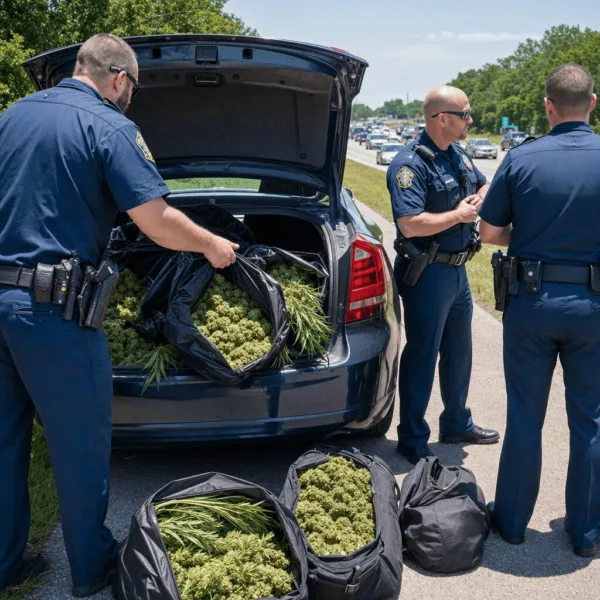
Here’s what happened, according to the original report from the Atmore Advance On a bright Alabama morning, a routine traffic stop along Highway 31 quickly escalated into a full-blown drug bust. Officers pulled over a Bay Minette woman’s sedan, and after a conversation, police searched the vehicle. Several clear bags containing what appeared to be marijuana buds and a white crystalline substance (later identified as methamphetamine), along with an open duffel bag and handcuffs, were discovered.
The arrest, which took place near Atmore, Alabama, started a debate about the difference between possession and intent to distribute, as these carry very different legal risks in the state. The woman was taken into custody and now faces significant penalties per Alabama law (Alabama Department of Public Health: Legal).
The incident wasn’t just about marijuana, since meth was also involved, raising worries over public safety. However, the seizure of cannabis again prompted debate over resource allocation by authorities, given how many states are changing direction on cannabis laws. This discussion mirrors broader issues, such as when ballot questions stir industry and voter concerns in different regions—Massachusetts recently experienced a significant stir when policy changes were brought directly to the public for a vote.
Expert Analysis: Lessons from the Highway 31 Drug Arrest and the Cannabis Industry
Let’s break it down with some honest analysis. The Highway 31 drug arrest highlights a trend seen across the U.S., with selective enforcement and ongoing criminalization of cannabis, even as public and professional opinion shifts toward legalization.
In the words of cannabis policy analyst Mason Tvert, quoted in Leafly’s recent report, “It’s increasingly clear that arresting individuals for marijuana possession makes little sense in a country where millions of adults purchase it legally.” That view can be seen at industry conferences and in every part of the cannabis community.
Yet, in places like Alabama, cannabis busts remain tied to old statutes, regardless of prevailing science or social priorities (NORML: Alabama Penalties). Reports show the impact of drug law enforcement is often hardest on marginalized groups. As digital interventions for substance use start to affect the wellness and choices of young adults, we see new strategies in education and harm prevention rising alongside shifting legal landscapes.
Future Outlook: From Highway 31 to Nationwide Legal Change
If there’s a silver lining to the Highway 31 drug arrest, it’s the fuel it adds to an already blazing conversation around cannabis law reform. The industry’s upward trajectory, with major markets like New York and Illinois opening doors (NBC News: New York Legalization), signals momentum that could eventually reach all 50 states.
Changing minds—and laws—requires moments like this to spark local debate and inspire action. Advocates will keep pointing to the data (cannabis arrests down where it’s legal, opioid risks down too; see JAMA Internal Medicine). Policymakers—and the public—need to keep up the conversation.
We’re seeing positive movement: more education, reduced stigma, and serious talk about restorative justice. The Highway 31 drug arrest won’t be the last, but maybe it’s the push needed in the right direction.
Originally reported by: atmoreadvance.com
1 Comment
Pingback: Shocking Details in Jonesboro Marijuana Handgun Arrest Exposed