


Second Amendment Showdown: Justice Department Contests Cannabis Gun Ban Amidst Legal Turmoil
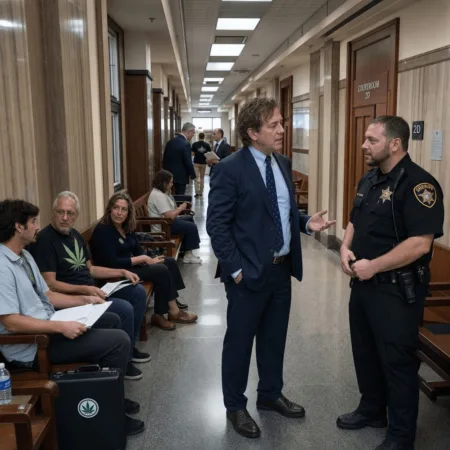
The Second Amendment’s intersection with the legality of cannabis consumption and firearm ownership has ignited a legal battle as the Justice Department challenges the constitutionality of a ban on cannabis consumers possessing guns. The department has expressed its disagreement with a recent ruling by the U.S. Court of Appeals for the Fifth Circuit that declared the prohibition unconstitutional. This pivotal issue is central to a related lawsuit currently under consideration by the U.S. Court of Appeals for the Eleventh Circuit.
With oral arguments scheduled for the forthcoming month in the Florida case, the Justice Department asserts that the ruling from the Fifth Circuit diverges from previous decisions that upheld the constitutionality of the firearm ban for cannabis consumers. The Department argues that this departure stems from the Fifth Circuit’s reliance on previous cases that the Supreme Court has reviewed, and asserts that the ruling in question contradicts the core principles enshrined in the Second Amendment.
In the ongoing legal proceedings, a representative for Florida’s medical cannabis patients affirmed their readiness to address the recent Fifth Circuit decision during the impending oral arguments. Notably, multiple courts have contested the federal firearms ban for cannabis consumers, with a growing consensus emerging against its constitutionality.
Central to this debate is a U.S. Supreme Court ruling from the previous year, emphasizing that any firearm restrictions must align with the historical context of the Second Amendment’s ratification in 1791. The recent decision by the Fifth Circuit highlights that the government has failed to effectively demonstrate a meaningful historic precedent for the ban on cannabis consumers possessing firearms. This ruling renders the ban invalid in states like Louisiana, Mississippi, and Texas, falling under the Fifth Circuit’s jurisdiction.
Conversely, the Eleventh Circuit, with jurisdiction over Alabama, Florida, and Georgia, remains a critical battleground for the ongoing legal dispute. Should this circuit uphold the constitutionality of the ban, it could lead to conflicting circuit holdings and potentially necessitate intervention by the Supreme Court.
Interestingly, even President Joe Biden’s son Hunter Biden’s case has been cited in the debate. Hunter Biden’s legal team has referenced a U.S. District Court decision that deemed the firearms ban for marijuana consumers unconstitutional. This case revolved around Hunter Biden’s purchase of a gun while being an active user of crack cocaine.
Notably, despite the evolving legal landscape, the U.S. Bureau of Alcohol, Tobacco, Firearms and Explosives (ATF) continues to maintain its stance that the marijuana firearms ban remains enforceable, even in states where cannabis has been legalized. However, the ATF has also updated its own cannabis employment policy, allowing individuals who complied with state laws while in positions of public responsibility to not be automatically disqualified.
In Congress, Republican lawmakers have introduced bills addressing the complex interplay between gun and marijuana policies. Representative Brian Mast of Florida filed legislation aimed at safeguarding the Second Amendment rights of marijuana users in legal states, while Representative Alex Mooney of West Virginia introduced a bill focusing on allowing medical cannabis patients to purchase and possess firearms.
Meanwhile, Arkansas has recently implemented a law that clarifies that medical marijuana patients can obtain concealed carry licenses for firearms. As this multifaceted legal battle continues to unfold, the nexus between cannabis consumption, firearm ownership, and Second Amendment rights remains at the forefront of legal discourse.